Quantities of Catches in the U.S. Alaska Pollock Fisheries
Incidental catches by the U.S. Alaska pollock fishery (Fishery) have been increasingly referenced by individuals who oppose the Fishery over concerns regarding the catch of other species in the Fishery. Some social media posts have cited “141 million pounds of bycatch in Alaskan “trawl fisheries” and have used this to generate support for measures that would restrict, and in some extreme cases, eliminate the Fishery. This document breaks down the amounts of catch in the Fishery, by species, and by categories that are used by the North Pacific Fishery Management Council (Council) and the National Marine Fisheries Service (NOAA Fisheries). The data represented herein are averages from 2020 to 2024.
Eastern Bering Sea
Catches by Management Category
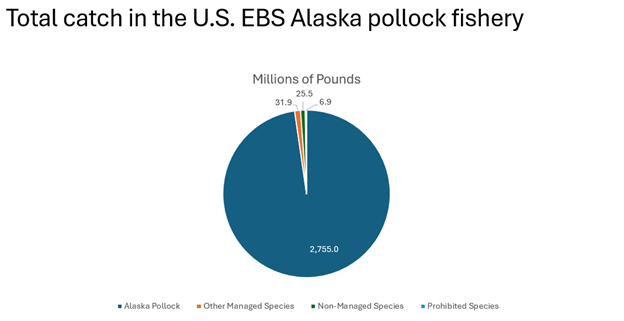
The above chart shows the catches of all species in the Eastern Bering Sea (EBS) Alaska pollock fishery. From 2020 to 2024, the catch of Alaska pollock averaged 2.755 billion pounds whereas catches of other species managed by the Council and NOAA Fisheries averaged 31.9 million pounds, the catch of non-managed species averaged 25.5 million pounds and the catch of Prohibited Species averaged 6.9 million pounds. Thus, the total harvest of non-Alaska pollock species averaged 64.3 million pounds. Each of these are presented in greater detail in this document.
Other Species Managed by the Council and NOAA Fisheries
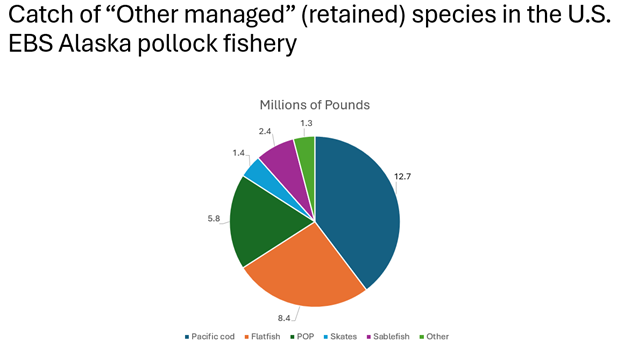
The average harvest of “other managed species” in the U.S. EBS Alaska pollock fishery was 31.9 million pounds, representing 50% of the total catch of non-Alaska pollock species in the fishery. While these species are obviously not Alaska pollock, the Council and NOAA Fisheries manage the complex that includes these species and apportions amounts of the Total Allowable Catches (TACs) of these species (which as a reminder is always set at or below the Acceptable Biological Catch (ABC)) for incidental catches in other fisheries. It does this not just for the Alaska pollock fishery, but all fisheries it manages as all these fisheries have bycatches of other species, to ensure that TACs are not exceeded. The Council and NOAA Fisheries allow retention of these species subject to limits called Maximum Retainable Amounts (MRAs) to ensure that vessels target Alaska pollock.
As the chart above shows, more than 60% of catches in this category are made up of Pacific cod and flatfish species (not including halibut as that is a Prohibited Species that is discussed later in that section). When retained, these species are produced into marketable products, including fish meal and oil.
Non-Managed Species
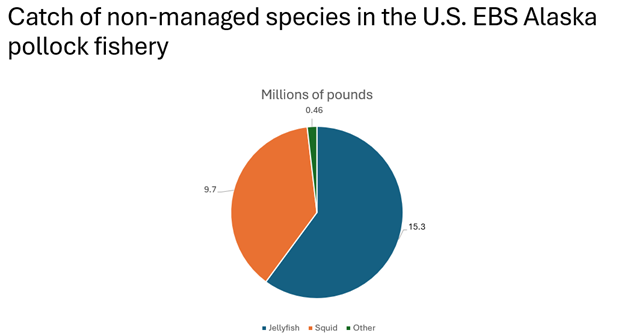
The second category for non-target species harvested in fisheries managed by NOAA Fisheries and the Council is “non-managed species.” As the chart above shows, the average catch of these species in the EBS Alaska pollock fishery was 25.46 million pounds. Of this, 25 million pounds, or 98.2% of the catch within this category, consists of jellyfish and squid. Included in the category of “other” are greenlings, sculpins, and grenadiers.
Combined with the catches of other species managed by the Council and NOAA Fisheries, these make up 89 percent of the total catches of non-Alaska pollock species in the EBS Alaska pollock fishery.
Prohibited Species
The Council and NOAA Fisheries have designated certain species, including herring, halibut, Chinook salmon, non-Chinook salmon, opilio and tanner crabs, and king crabs as “Prohibited Species.” These species are not allowed to be retained in the EBS Alaska pollock fishery except when they are donated to food banks under special regulations enacted by NOAA Fisheries and the Council.
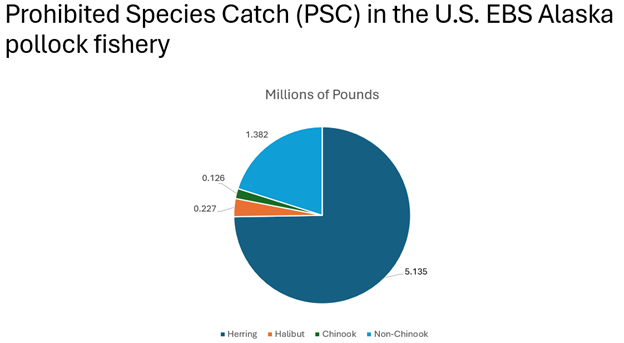
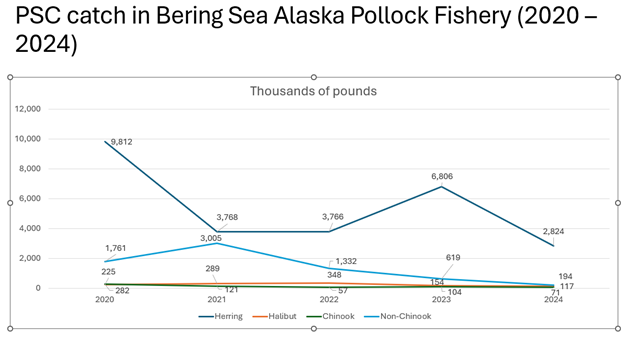
The chart above provides the weight in pounds for finfish Prohibited Species. NOAA reports the Prohibited Species catches for herring and halibut by weight, but reports salmon in numbers of fish. The historical average weights of Chinook and non-Chinook salmon incidentally harvested in the EBS Alaska pollock fishery from observer data for the catcher-processor were used to convert the number of salmon to weights. The PSC of crab are not included here, but we can report the average number of crab caught in the EBS Alaska pollock fishery from 2020 to 2024. These numbers are as follows:
Species # crab
Opilio 12,255
Bairdi 9,140
Red king crab 216
Golden king crab 188
Blue king crab 12
The catches of finfish Prohibited Species averaged 6.9 million pounds from 2020 to 2024, 5.135 million pounds (75 percent) of which was herring. The incidental catches of halibut averaged just over 226 thousand pounds, while the incidental catch of Chinook salmon averaged 127 thousand pounds and the catch of non-Chinook salmon averaged 1.38 million pounds. It is worth noting that as a result of actions taken by industry to reduce their incidental catches, the 2024 catches (in lbs) of these species were well below the five year average as shown below. Note this is particularly true for non-Chinook salmon where the 2024 bycatch was 14% of the five-year average.
|
|
Herring |
Halibut |
Chinook salmon |
Non-Chinook salmon |
|
2020-2024 Ave. |
5,134,954 |
226,633 |
126,985 |
1,382,284 |
|
2024 |
2,824,093 |
116,844 |
70,547 |
194,005 |
Gulf of Alaska
Catches by Management Category
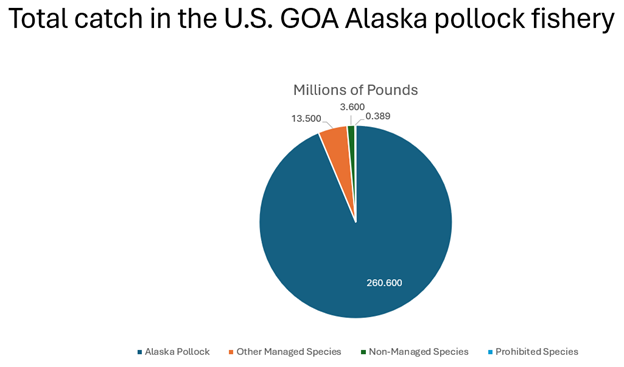
The above chart shows the catches of all species in the Gulf of Alaska (GOA) Alaska pollock fishery. From 2020 to 2024, the catch of Alaska pollock averaged 260.6 million pounds whereas catches of other species managed by the Council and NOAA Fisheries averaged 13.5 million pounds, the catch of non-managed species averaged 3.6 million pounds and the catch of Prohibited Species averaged 389,000 pounds. Thus, the total harvest of non-Alaska pollock species averaged 17.5 million pounds. Each of these categories are presented in greater detail in this document.
Other Species Managed by the Council and NOAA Fisheries
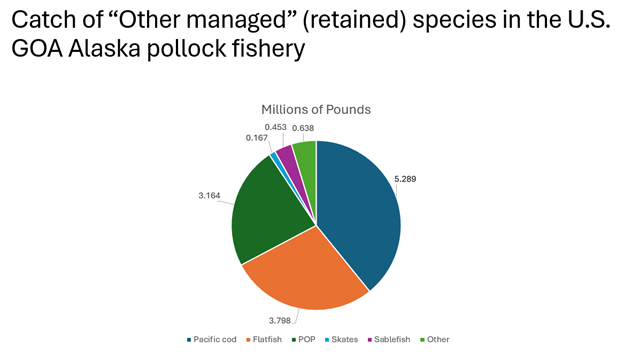
The average harvest of “other managed species” in the U.S. GOA Alaska pollock fishery was 13.5 million pounds, representing 77% of the total catch of non-Alaska pollock species in the fishery. While these species are obviously not Alaska pollock, the Council and NOAA Fisheries manage the complex that includes these species and apportions amounts of the Total Allowable Catches (TACs) of these species (which as a reminder is always set at or below the Acceptable Biological Catch (ABC)) for incidental catches in other fisheries. It does this not just for the Alaska pollock fishery, but all fisheries it manages as all these fisheries have bycatches of other species, to ensure that TACs are not exceeded. The Council and NOAA Fisheries allow retention of these species subject to limits called Maximum Retainable Amounts (MRAs) to ensure that vessels target Alaska pollock.
As the chart above shows, more than two-thirds of catches in this category are made up of Pacific cod and flatfish species (not including halibut as that is a Prohibited Species that is discussed later in that section). When retained, these species are produced into marketable products, including fish meal and oil.
Non-Managed Species
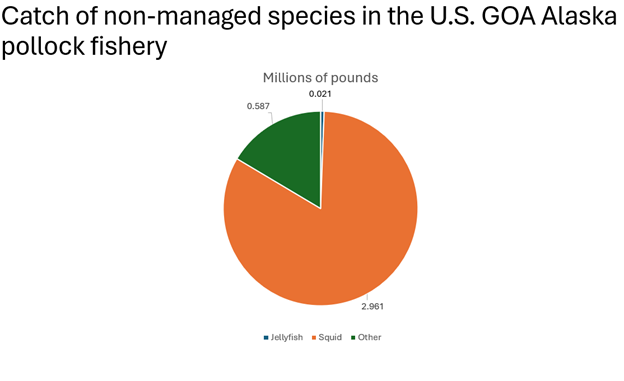
The second category for non-target species harvested in fisheries managed by NOAA Fisheries and the Council is “non-managed species.” As the chart above shows, the average catch of these species in the GOA Alaska pollock fishery was 3.57 million pounds. Of this, 2.96 million pounds, or 86% of the catch within this category, consists of squid. Included in the category of “other” are greenlings, sculpins, and grenadiers.
Combined with the catches of other species managed by the Council and NOAA Fisheries, these make up 97.8 percent of the total catches of non-Alaska pollock species in the GOA Alaska pollock fishery.
Prohibited Species
The Council and NOAA Fisheries have designated certain species, including herring, halibut, Chinook salmon, non-Chinook salmon, opilio and tanner crabs, and king crabs as “Prohibited Species.” These species are not allowed to be retained in the GOA Alaska pollock fishery except when they are donated to food banks under special regulations enacted by NOAA Fisheries and the Council.
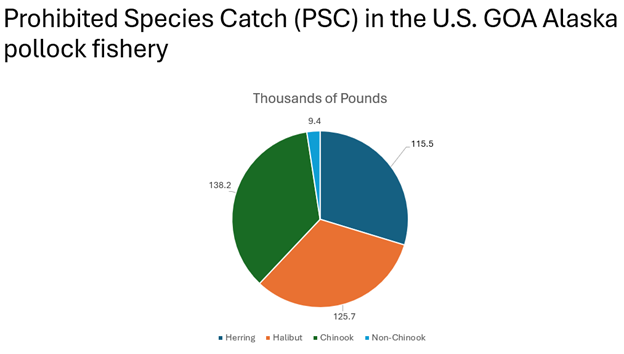
The chart above provides the weight in pounds for finfish Prohibited Species catch in the GOA Alaska pollock fishery. NOAA reports the Prohibited Species catches for herring and halibut by weight but reports salmon in numbers of fish. The historical average weights of Chinook and non-Chinook salmon incidentally harvested in the EBS Alaska pollock fishery from observer data for the catcher-processor were used to convert the number of salmon to weights. The PSC weights of crab are not included here, but the average number of crab caught in the GOA Alaska pollock fishery from 2020 to 2024 are as follows:
Species # crab
Opilio 0.025
Bairdi 1,034
Red king crab 0.7
Golden king crab 5.28
Blue king crab 0
The catches of finfish Prohibited Species averaged 388.7 thousand pounds from 2020 to 2024, 115.5 thousand pounds (30 percent) of which was herring. The incidental catches of halibut averaged just over 125.7 thousand pounds, while the incidental catch of Chinook salmon averaged 138.2 thousand pounds and the catch of non-Chinook salmon averaged 9,428 pounds.