December 16, 2025
Why Alaska Pollock Fits the Low-Carbon Food Moment
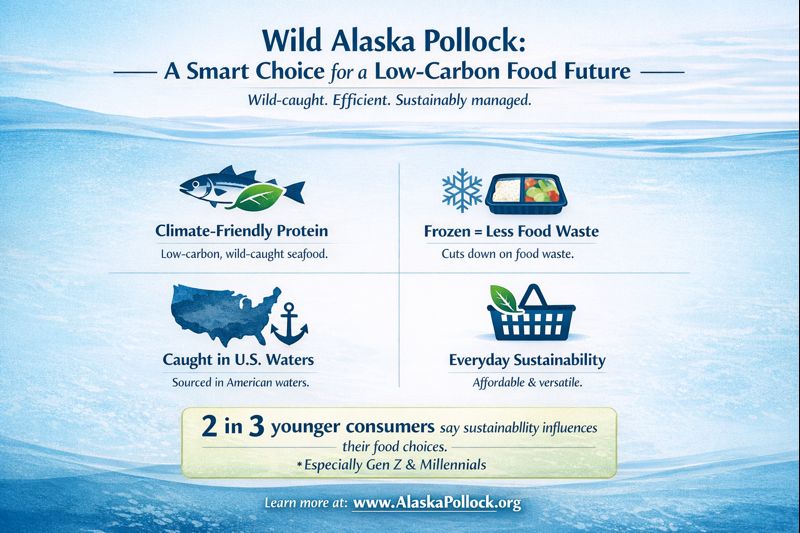
As conversations about climate change move from headlines to grocery carts, food choices are becoming one of the most tangible ways consumers express their values. Increasingly, shoppers aren’t just asking What tastes good?—they’re also asking What has a lighter footprint?
Across retail, foodservice, and campus dining, low‑carbon foods are emerging as a major trend. Few proteins align with this shift as naturally as Wild Alaska Pollock.
Climate-Friendly Proteins Are Going Mainstream
Protein choice is one of the largest drivers of a meal’s environmental impact, and consumers are paying attention.
- Surveys consistently show that younger consumers care most: roughly two‑thirds of Gen Z and Millennials say sustainability influences their food purchases at least sometimes.
- Flexitarian eating is now mainstream, with many consumers reducing red meat rather than eliminating animal protein altogether.
In this environment, seafood—especially wild‑caught species—benefits from being seen as a middle ground: high-quality animal protein with a significantly lower carbon footprint than beef or lamb.
Alaska Pollock fits squarely into this trend. Wild-caught in the U.S. and harvested from one of the world’s best-managed fisheries, it delivers protein efficiently, without the feed, land use, or methane emissions associated with ruminant livestock.
Low-Impact Seafood: Awareness Is Rising
Consumers may not always use the phrase “low carbon,” but they respond strongly to cues like:
- Responsibly sourced
- Ocean-friendly
- Sustainably managed
Seafood is increasingly recognized as a climate-smart protein, particularly when it is wild-caught. Lifecycle assessments repeatedly show that wild-capture fisheries with healthy stocks and efficient harvest methods rank among the lowest-emission animal proteins.
Alaska Pollock stands out here. The fishery is certified sustainable, tightly managed, and remarkably efficient—meaning more edible protein with less environmental input. For climate-conscious shoppers, that story matters.
Frozen Foods and the Carbon Conversation
One of the most important—and overlooked—low-carbon trends is the rehabilitation of frozen food.
Food waste is responsible for an estimated 8–10% of global greenhouse gas emissions, and consumers are increasingly aware of that connection. Frozen foods help address this by:
- Extending shelf life
- Reducing spoilage at home
- Supporting portion control
Alaska Pollock is most often sold frozen, which positions it well with consumers who want to reduce waste without sacrificing convenience or quality. For families, students, and value-driven shoppers, frozen Pollock checks multiple boxes: affordable, versatile, and climate-conscious.
Domestic Sourcing Builds Trust—and Cuts Emissions
Origin matters more than ever. Research shows that a majority of U.S. consumers say they trust domestically produced food more than imports, and many associate U.S. sourcing with higher environmental standards.
Alaska Pollock is:
- Wild-caught in U.S. waters
- Harvested under strict science-based management
- Processed through highly efficient supply chains
Shorter, more transparent supply chains don’t just build confidence—they can also reduce unnecessary emissions tied to reprocessing, waste, and inefficiency.
Carbon Literacy Without the Complexity
While interest in climate-friendly food is high, consumers don’t want a math lesson at the dinner table.
The fastest-growing messaging around low-carbon food avoids exact numbers and instead focuses on:
- “Lower-impact choice”
- “Lighter footprint”
- “Responsibly sourced protein”
Alaska Pollock fits this simplified communication style well. Its sustainability story is strong enough to be told clearly, without jargon, and familiar enough to feel accessible—not extreme.
Who Cares Most About Low-Carbon Food?
While concern spans generations, data consistently shows higher engagement among:
- Gen Z and Millennials, especially urban and college-educated consumers
- Parents, who connect sustainability with long-term family health
- Campus and institutional diners, where climate labeling and sustainability commitments are growing
These audiences also value affordability and convenience—making Alaska Pollock’s role as a versatile, value-driven protein especially relevant.
The Bottom Line: Everyday Sustainability
Low-carbon food isn’t about perfection—it’s about practical progress.
Alaska Pollock succeeds in today’s food landscape because it delivers:
- Great taste and versatility
- Strong sustainability credentials
- Affordability and accessibility
- Alignment with climate-conscious values
As consumers look for simple ways to make better choices, Alaska Pollock proves that climate-smart food can also be familiar, affordable, and delicious.
In a world where every choice adds up, that’s a win worth sharing.

